
Contexto Tips & Strategies
The difference between a 300-guess slog and a 25-guess win is rarely vocabulary — it is method. Everything below is backed by our database of every puzzle ever published, from the opening guess to the final tiebreaker — no folklore, just patterns the numbers actually support.
TL;DR — the five rules that matter most
- Open with broad nouns from different domains — never two from the same one.
- Expect a 4–7 letter everyday noun: that range covers 74% of all answers.
- Recycle past answers as guesses — 86.1% of puzzles rank one inside their top 5.
- Chase gradients (directions that improve), not individual scores.
- Under rank 100, stop guessing categories and start guessing things.
Best Starting Words
The Opener List
A good opener maximizes information, not the chance of a lucky hit. Broad, high-frequency nouns each "claim" a large territory of the semantic map:
thing · person · place · food · animal · water · house · work · idea · machine · body · money
Open with three or four from different domains. Their relative ranks form a rough triangulation before you have really started.
Never open with two words from the same domain — a second data point on known territory is a wasted guess.
The Domain Checklist
If nothing scores well, walk categories systematically: nature → objects → people & roles → actions → abstract concepts → body & health → food → technology.
Answers are drawn from everyday vocabulary, so one of these always lights up.
The 30-Second Pre-Game Ritual
Before your first guess, decide three things: which four domains you will open with, what rank you will treat as "warm" today (100 is a good default), and how many guesses you will spend before opening a hint.
It sounds bureaucratic; it is the opposite. Players who pre-commit stop spiraling into panic-guessing at rank 800 — the single biggest guess-waster there is.
The Data-Backed Opener: Guess Past Answers
Here is the strategy no generic guide can give you. We cross-referenced every puzzle's top-5 closest words against the full answer history, and the overlap is remarkable:
In 86.1% of all Contexto puzzles (1,252 of 1,454), at least one other puzzle's answer appears inside the top 5 closest words.
In other words: the game keeps drawing from the same everyday-noun pool, so yesterday's answers are statistically excellent guesses for today. Skim the answer archive now and then — the words you remember from it double as a pre-optimized opener deck.
What 1,454 Answers Taught Us
We maintain a database of every Contexto answer since #0 (September 18, 2022) plus each puzzle's closest words. Here is what the whole history says about what you are actually hunting for.
A note on method: every number in this section is computed directly from that database at build time, so the charts below update automatically as new puzzles are added — they are never estimates or samples.
Answer Length: Aim for 4–7 Letters
The average answer is 6.0 letters long, and the 4–7 letter band covers 74% of every puzzle ever published. The extremes are rare outliers — the shortest answer so far is "tv" and the longest is "advertisement".
Answer length distribution · all 1,454 puzzles · greener = more common
Practical use: when you are close and juggling candidates, prefer the mid-length everyday noun over the exotic long one.
First Letters: C, S, P Dominate
C (179), S (166), P (132) lead the first-letter table — together they open 33% of all answers. Z, U, and Q barely register.
Answers by first letter · darker green = more common
This is endgame fuel, not opener fuel: letters are invisible to the ranking, but when two candidates feel equally close, the base rates break the tie.
What This Means for Your Openers
Put the two length facts together and the opener profile writes itself: a 4–7 letter everyday noun, more likely than not starting with a common consonant. Your broad openers already fit this profile — which is part of why they work.
Answers Almost Never Repeat
Across the entire history, only 2 words have ever appeared twice: "glass" and "firework". Everything else — 1,450+ puzzles — used a fresh word.
So cross today's archive off your candidate list, but keep it in your guess vocabulary: as the overlap stat above shows, retired answers stay semantically close to new ones.
Reading Gradients
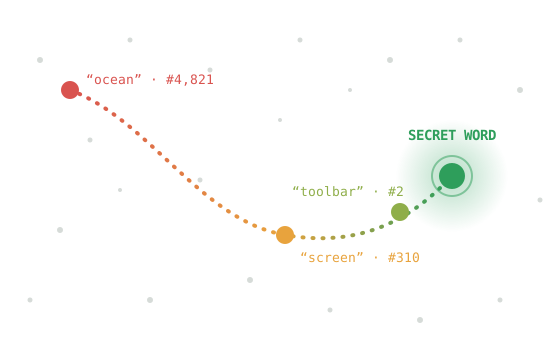
Single ranks are noisy; directions are signal. A gradient is a chain of guesses whose ranks keep falling — follow it and it walks you to the answer.
A Real Example: Puzzle #1395
Take Contexto #1395, where the answer was EVIDENCE. The AI's top-ranked neighbors were "testimony", "prove", "conclusive", "circumstantial", and "empirical". Watch how a real solve narrows:
Each step follows the improving direction: legal system → courtroom → the people in it → what they produce. That last leap — "what does a witness give?" — is gradient reading in one question.
Branch from Your Best Word
Always branch from your current best word, not your latest word. Players drift into exploring their most recent guess even when an earlier one scored better — re-read your rank list every few guesses.
When a Line Stalls
The moment ranks stop improving, do not abandon ship. Back up to your best word and branch sideways — a stall usually means you overshot the target's specific sense, not that the neighborhood was wrong.
The Endgame
Under Rank 100: Guess Things, Not Categories
Inside the top 100, stop guessing categories and start guessing things: concrete nouns, close synonyms, parts and wholes of your best word.
Under rank 10, try every direct relative. If your best word is "logo", the family is "symbol", "image", "badge", "emblem", "icon" — one of them is usually the door.
The Sense Trap
Many words have several senses. If your gradient stalls near the top, ask which sense the model might favor — "mouse" the animal versus the device leads to opposite corners of the map.
The tell is a cluster of good-but-not-great ranks: five words between 60 and 150 that refuse to improve. That plateau almost always means right theme, wrong sense. Deliberately guess one word from each competing sense and let the ranks vote.
How Many Hints Should You Use?
Strategically: as few as break the stall. Our hint ladder is graded precisely so that one level — usually the category — restarts a dead game. Set a rule like "25 guesses per hint level" and the game stays a game instead of becoming a lookup.
Using Word-Shape Data
This is where the statistics above pay off: between two final candidates, prefer the 4–7 letter one, and lean toward common first letters. It is a tiebreaker, not a strategy — but endgames are decided by tiebreakers.
A Worked Endgame
Suppose your best word is "kitchen" at rank 8. The category route ("room", "cooking") is already exhausted — those are what got you here. The endgame move is to enumerate the things: "stove", "sink", "oven", "counter", "fridge".
Five candidates, one real guess to spare? This is the exact moment the Word Tester earns its place — test four, commit the winner, keep your guess count clean.
Practice Drills That Actually Work
Strategy reading gets you 60% of the way; a few minutes of deliberate practice does the rest. Three drills, in ascending order of effort:
Drill 1 — The Post-Game Review (2 minutes)
After every solve, open that puzzle's page in our archive and read the top-5 closest words. Ask one question: "which of these would I have tried, and which surprised me?" The surprises are your blind spots.
Drill 2 — The Archive Replay (10 minutes)
Replay an old puzzle from the game's archive mode, but with a constraint: maximum 25 guesses. The cap forces you to follow gradients instead of spraying — and our per-puzzle hint pages are there if you stall.
Drill 3 — Calibration Testing (5 minutes)
Once a week, pick a finished puzzle and use the Word Tester to check five words you believe are close. Guessing their ranks before revealing them — then seeing the truth — is the fastest calibration exercise we know.
Common Mistakes That Waste Guesses
- Synonym-cycling your own guesses. Five words meaning "big" are one data point, not five.
- Ignoring other parts of speech. When nouns stall, verbs and adjectives from the same scene often break through.
- Abandoning a good rank. A sub-100 word is gold; never restart cold from another domain.
- Chasing rare words. The data is unambiguous — answers are common vocabulary. "Obsidian" is almost never the target.
- Playing tilted. After ten bad ranks in a row, frustration guessing sets in and quality collapses. Step away for a minute, or take one hint level — a calm guess is worth three angry ones.
Want to test a hunch without burning an in-game guess? That is exactly what our Word Tester is for — and if today's puzzle has you stuck right now, the graded hint ladder will get you moving again.
Contexto Strategy FAQ
What is the best starting word for Contexto?
There is no single magic opener — the best first guesses are broad, high-frequency nouns like "thing", "person", "place", or "food" that each cover a large territory of meaning. Our data adds one twist: past answers make excellent openers, because 86.1% of puzzles rank at least one other puzzle's answer inside their top 5 closest words.
How many guesses does an average Contexto game take?
Community reports cluster around 30–80 guesses for a normal solve, with hard puzzles running past 200. Method matters more than vocabulary: players who follow rank gradients instead of guessing randomly routinely finish in under 30.
Do Contexto answers repeat?
Almost never. Across all 1,454 puzzles to date, only 2 words have ever appeared twice ("glass" and "firework"). Treat every previous answer as retired — but keep them as guesses, since they often rank close to new answers.
Are Contexto answers ever plural?
Rarely — only 38 answers in the entire archive end in "s", and most of those are not plurals at all. Guess the singular form; the game maps plural guesses to almost identical ranks anyway.
How do I get faster at Contexto?
Three habits compound quickly: open with domain-spanning nouns, always branch from your best-ranked word rather than your latest one, and review the closest-words table after each game in our archive — it is a daily lesson in how the AI clusters meaning.