
How to Play Contexto
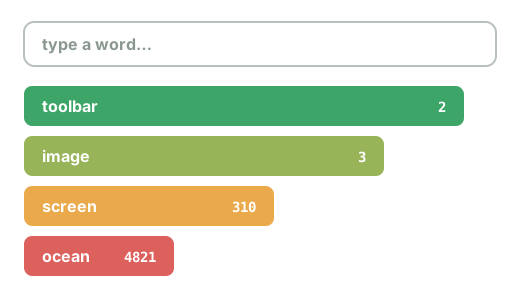
Contexto looks simple — a text box and a list of guesses — until the game tells you "ocean" is rank 4,821. Two minutes here and the numbers will make sense — and by the end you will know exactly what to do with every color the game throws at you.
The Rules in 30 Seconds
A secret word is chosen every day — always a single English word, usually a common noun.
Type any word. The game ranks it: #1 is the closest word to the secret one, higher numbers are further away.
No guess limit, no timer. You win by typing the secret word itself — the score is how few guesses it took.
That is the entire rulebook. The skill is in what the numbers mean — and that is where most new players get lost.
A new puzzle arrives at midnight in your local time zone, numbered sequentially — today's is #1457. Miss a day and nothing is lost: the archive mode keeps every past puzzle playable, and our answer archive covers them all.
How the Ranking Works
A Map of Meaning
The game uses a word-embedding model — a map of English where words that appear in similar contexts sit close together. "Coffee" lives near "tea" and "cup", and far from "algebra".
The map was built by an AI reading enormous amounts of real text and noting which words keep each other's company. No human curated it — which is why it sometimes disagrees with your dictionary instincts, and why learning its quirks is half the fun.
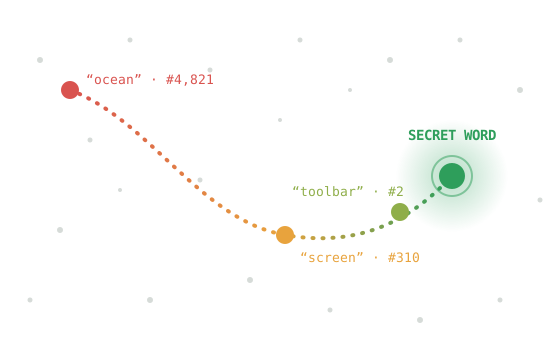
You are not guessing spellings — you are navigating a map of meaning, and every guess is a compass reading.
What the Rank Number Means
Your rank is your word's position in the full closeness list for today's secret word. The dictionary behind the game holds tens of thousands of entries, so even rank 2,000 has already ruled out most of the map.
One consequence surprises everyone: a "bad" rank is still information. Three red guesses in different domains eliminate three whole territories.
Green, Yellow & Red
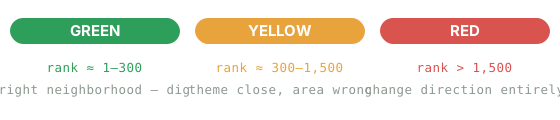
The colored bar under each guess is a quick visual for the same number:
Why Your "Perfect" Guess Ranked Badly
Every new player hits this: you guess what feels like an obvious synonym and it lands at rank 900. The model is not judging dictionary meaning — it is judging company: which words actually appear together in real writing.
A formal synonym that nobody uses in everyday sentences can rank worse than a loosely related common word. When a "perfect" guess flops, do not argue with the map — ask what ordinary word people would actually say in that context instead.
Contexto vs. Wordle vs. Semantle
If you arrive from another daily word game, the fastest way to understand this one is by contrast:
| Contexto | Wordle | Semantle | |
|---|---|---|---|
| Feedback | Similarity rank | Letter positions | Raw similarity score |
| Guess limit | Unlimited | 6 | Unlimited |
| Core skill | Meaning navigation | Letter deduction | Meaning navigation |
| Readability | Rank + color bars | Green/yellow tiles | Decimal scores |
Wordle instincts transfer poorly — letters are irrelevant here until the endgame. Semantle instincts transfer well, and most players find ranks far easier to read than Semantle's raw similarity decimals.
The unlimited guess count changes the psychology too: there is no fail state, so experimentation is free. The players who improve fastest are the ones who treat early guesses as questions rather than attempts.
Your First Game, Step by Step
Step 1 — Open Wide
Start with three or four broad nouns from different domains: person, food, machine, nature.
Whichever scores best tells you which quarter of the map to explore. (Our strategy guide has a data-backed opener list.)
Step 2 — Follow the Gradient
Take your best word and try its neighbors. If machine leads, try computer, engine, tool — and push in whichever direction the rank improves.
Think of it as a warmer/colder game played on meaning: each guess is a probe, and the trend across your last few probes matters far more than any single number.
Step 3 — Close the Circle
Once you crack the top 100, think of the specific everyday things in that area. Under rank 10, the answer is usually a direct neighbor — a synonym, a part, or the whole of your current best word.
A Full Mini-Solve, Annotated
Here is how those three steps chain together in a real game. Openers: "person" (2,100), "machine" (450), "nature" (3,800) — machine's quarter it is.
Neighbors of machine: "computer" (120), "engine" (900) — the computer direction is warm. Digging: "screen" (35), "keyboard" (60), "desktop" (4). At rank 4, enumerate desktop's direct relatives — "icon" wins the game.
Eight meaningful guesses, no luck involved. That is the whole method; everything in our strategy guide is refinement of these moves.
How to Read Your Results
Bookmark this table — it maps every rank range to what you should do next:
| Rank | What it means | Your next move |
|---|---|---|
| 1–10 | Practically touching it | Guess direct relatives: synonyms, parts, wholes |
| 11–100 | Right neighborhood | Stay here — guess concrete things, not categories |
| 101–300 | Edge of the neighborhood | Branch sideways from your best word |
| 301–1,500 | Theme close, area wrong | Try a different sense or sub-topic of the theme |
| 1,500+ | Wrong territory | Change domain entirely — the red guess still ruled one out |
Want to practice reading ranks without touching your game stats? Type a few words into our Word Tester — it shows the exact rank for today's puzzle.
Modes & Features Worth Knowing
Give Up
The menu's "give up" option reveals the answer and ends the day's run. Before you use it, try the graded hint ladder — a category nudge rescues most stuck games without spoiling the win. If you do fold, read the closest words afterwards; a lost game reviewed is worth more than a lucky one forgotten.
Archive Replay
You can replay any past puzzle from the game's archive. Pair it with our answer archive — every past puzzle has its own hints page, so you can rescue an archive run the same way as today's.
Streaks & Stats
The game tracks your solve streak and guess counts. Nothing on this site touches those numbers — checking a hint or testing a word here is invisible to your stats.
Sharing Your Result
After solving, the game generates a spoiler-free share card showing your guess count as colored squares. Sharing it never reveals the answer — which is why your group chat can compare scores before everyone has played.
Seven Mistakes Every New Player Makes
- Treating it like Wordle. Letters and word length are invisible to the ranking — meaning is everything.
- Quitting on red. A far rank is information: one whole territory eliminated in one guess.
- Guessing rare words. Answers are everyday vocabulary; "obsidian" flatters your ego and wastes a guess.
- Synonym-cycling. Five words meaning "big" are one data point, not five.
- Chasing the latest guess. Always branch from your best word, not your most recent one.
- Ignoring verbs and adjectives. When nouns stall, the same scene's actions and qualities often break through.
- Panic-guessing after rank 500. Slow down, re-read your list, pick one direction — speed comes from method, not typing.
Recognize yourself in a few of these? Good — every experienced player does. The strategy guide is the systematic cure.
Contexto Glossary
Rank
A word's position in the similarity list for today's secret word. Rank #1 is the closest word in the dictionary that is not the answer itself.
Semantic Similarity
How close two words are in meaning, measured by how often they appear in the same real-world contexts — the metric behind every rank in the game.
Embedding
The AI technique that turns each word into coordinates on a map of meaning, so that "distance between words" becomes something a computer can calculate.
Gradient
A chain of guesses whose ranks keep improving. Following gradients — rather than judging guesses one at a time — is the core skill of the game.
Lemma
The base form of a word. The game maps inflections to their lemma — "running" and "ran" score like "run" — which is why guessing plural or past-tense variants rarely changes anything.
Neighborhood
Informal term for the cluster of words closest to the answer. "Finding the neighborhood" (any guess under ~100) is the halfway point of every solve.
Your Second Week: From Finishing to Finishing Fast
The first few games are about finishing at all. Once that is routine, three habits compress your guess count quickly.
Log your openers. Notice which of your standard openers scored best each day. Over a week you will see which domains the game favors — and our data section confirms the pattern with numbers.
Review the closest words. Every puzzle page in our archive lists what actually ranked near the answer. Two minutes of review per day rewires your intuition faster than any rule.
Set a hint budget. Decide in advance: 25 guesses, then one level of the hint ladder, then ten more guesses. Structure keeps the game fun on the days the map feels foggy.
How-to-Play FAQ
Is Contexto free to play?
Yes — the game is free in any browser with no account required, and it also has official mobile apps. Our hints, answers, and Word Tester are free too.
How many guesses do you get in Contexto?
Unlimited. There is no guess cap and no timer — the challenge is finishing in as few guesses as possible, not beating a limit.
What does the number next to my guess mean?
It is your word's similarity rank: its position in the full closeness list for today's secret word. Rank #1 is the closest word in the dictionary that is not the answer itself; #5,000 is far away.
Does spelling or word length matter?
No. Contexto compares meanings, not letters — "cat" and "category" are unrelated to the game despite sharing letters. Letter patterns only help you at the very end, when choosing between two close candidates.
Can I play past Contexto puzzles?
Yes. The game's archive mode lets you replay any previous puzzle — and our answer archive has hints and full analysis for every one of them, back to #0.
What is a good score in Contexto?
Under 30 guesses is a strong solve, under 15 is excellent, and single digits usually mean a lucky opener. Anything under 80 is perfectly respectable — the community average sits somewhere in that band on normal days.